She Wore Her Scars Like Armor, and They Called Her a Villain
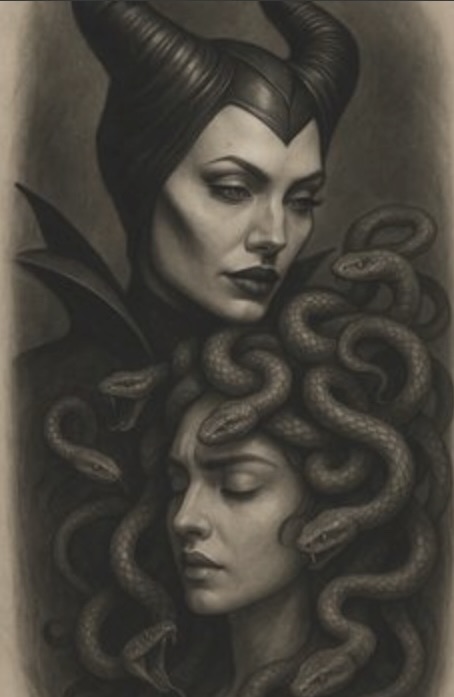
Growing up, we knew them as the villains. The monsters. The ones to fear.
Medusa, the snake-haired Gorgon, whose very gaze turned men to stone.
Maleficent, the dark fairy who cursed an innocent baby out of spite.
These were the stories we were fed. Simple narratives with clear villains and heroes. But like so many stories written by those in power, they left out the most important part: What happened BEFORE they became the "monsters"?
The Women They Called Monsters Teach Us How to Be Unbreakable! The Truth They Didn't Want You to Know
Let's tell the real story.
Medusa: The Priestess Who Was Punished for Being Violated
Medusa was once a beautiful young woman, a devoted priestess of Athena who had taken a vow of celibacy to serve the goddess she loved. She was faithful. She was pure. She was dedicated. Then Poseidon, the powerful god of the seas, saw her and wanted her. In some versions, he seduced her. In others, the ones that ring most true, he forced himself upon her. And where did this violation happen? In Athena's own temple. When Athena discovered what had occurred in her sacred space, she was enraged. But she couldn't punish Poseidon; he was a god, untouchable, protected by divine privilege.
So instead, she punished the victim. Athena transformed Medusa, the woman who had devoted her life to her, the woman who had been violated in her temple, into a monster. Her beautiful hair became writhing serpents. Her lovely face became something men couldn't look upon without turning to stone. Medusa was cast out. Exiled. Made into the villain of a story where she was the one who had been wronged.
Maleficent: The Betrayed Protector
We see this same pattern in Maleficent's story, particularly in the retelling that peels back the fairy tale veneer. Maleficent wasn't born evil. She was a powerful fairy, a protector of her realm, someone who loved deeply and trusted fully. She opened her heart to Stefan, who she believed loved her in return. But Stefan wanted power more than love. And he knew that to become king, he needed to defeat the powerful Maleficent. So he betrayed her in the most intimate, violating way; he drugged her and cut off her wings while she slept, taking her power to claim his throne. Then he painted HER as the villain. The dangerous one. The monster who needed to be feared.
The Pattern: How Power Protects Itself
Do you see it?
The one who holds power commits the violation. The victim is then transformed, by that very power, into the villain of the story.
It's not just mythology. It's a tale as old as time, replayed in countless lives:
The woman who speaks up about abuse is called "difficult" or "crazy"
The person who sets boundaries is labeled "cold" or "mean"
The survivor who shows their scars is told they're "dwelling in the past"
The one who refuses to shrink is painted as "too much"
Medusa and Maleficent aren't just ancient stories. They're mirrors held up to a pattern that still exists today, where those who are hurt are often recast as the ones who are dangerous.
But Here's Where the Real Power Begins
Because here's what those who wrote these stories didn't count on:
Medusa OWNED her transformation. Maleficent RECLAIMED her narrative.
They didn't spend their lives begging to be seen as beautiful again. They didn't apologize for becoming what pain and betrayal had forged them into.
Instead, they became something those in power truly had reason to fear.
Medusa: The Gaze That Holds Boundaries
After her transformation, Medusa's gaze became her greatest power. Anyone who looked upon her turned to stone. Think about that symbolically. She no longer had to explain herself. She no longer had to plead her case or convince anyone of her worth. She no longer had to tolerate those who came at her with ill intent.
Her very presence, her authentic, unmasked presence, stopped violators in their tracks.
This is the power of fierce boundaries. This is what it means to no longer shrink yourself to make others comfortable. When you fully own who you are, when you stop apologizing for your transformation, when you refuse to dim your power, you become the kind of force that makes those with bad intentions turn away.
Medusa teaches us: Your fierce truth is your protection.
Maleficent: The Love That Comes After
Maleficent's journey takes us one step further.
After her betrayal, after her transformation into the so-called villain, she could have closed her heart forever. She could have decided that all love leads to pain, that trust is for fools, that power is all that matters. And for a time, perhaps she did.
But then came Aurora. The daughter of her betrayer. The child she had cursed in her rage and pain. And Maleficent, this "villain," this "monster," discovered something profound: She could still love. Her heart wasn't dead. Her capacity for tenderness hadn't been destroyed by what was done to her. She learned that loving again after betrayal isn't weakness, it's the ultimate reclamation of power. It's refusing to let those who hurt you dictate how you move through the rest of your life.
The Gifts They Carry: Resilience, Power, and Fierce Love
So what do Medusa and Maleficent really teach us?
1. You Are Not Defined by What Was Done to You
Yes, terrible things happened to them. Violations. Betrayals. Injustices.
But their stories don't end there. They transformed their pain into something else, into presence, into power, into protection. You are not just what happened to you. You are what you become in response to it.
2. Your Boundaries Are Sacred and Powerful
Medusa's gaze stopped violators cold. She didn't have to explain, justify, or soften herself.
When you hold your boundaries with that kind of unwavering certainty, you don't need anyone's permission or understanding. Your "no" is complete. Your presence speaks for itself. Fierce boundaries aren't mean. They're self-love in action.
3. Transformation Isn't Pretty, But It's Yours
Both Medusa and Maleficent were transformed by pain into something society called "monstrous." But that transformation was also what made them powerful. The snakes. The darkness. The sharp edges. These weren't weaknesses; they were the very things that made them forces to be reckoned with. Your rough edges, your scars, your "too muchness" these aren't flaws. They're your medicine. They're your power.
4. Stand in Your Truth with Courage
Even when the world calls you the villain, stand firm.
Even when they twist your story, own your narrative.
Even when they try to shame you for your power, wear it like a crown.
Medusa and Maleficent refused to apologize for existing fully, powerfully, authentically. They refused to diminish themselves to make others comfortable.
This is courage: being who you truly are even when the world wants you small.
5. You Can Still Love Fiercely, Without Losing Yourself
This is where Maleficent's journey becomes transcendent.
She shows us that you can set fierce boundaries AND still have a tender heart. You can refuse to be hurt again AND still choose to love. You can be powerful, protective, even intimidating, and still vulnerable with those who've earned it.
The goal isn't to close your heart. It's to guard it wisely while keeping it open to real love.
The Legacy They Leave Behind
And here's something beautiful about Medusa's story that often gets overlooked:
When Perseus beheaded her, two beings sprang from her neck: Pegasus, the magnificent winged horse, and Chrysaor, wielding a golden sword.
From her deepest pain, from her very death, came beauty and power incarnate.
Even in her end, Medusa created life. Even after everything taken from her, she birthed something extraordinary into the world.
This is the resilience these stories teach us: Even when you feel destroyed, even when it seems like everything has been taken, you still carry the capacity to create, to transform, to birth new beauty and power from your wounds.
Reclaiming the Monster
So maybe it's time we stop calling them villains.
Medusa and Maleficent are not cautionary tales about what happens when women have too much power or hold too much rage.
They're empowerment stories about what happens when you refuse to let trauma define you, when you own your transformation, when you stand in your truth with such fierce integrity that those who would harm you can't even approach you.
They teach us:
To be resilient in the face of betrayal.
To be strong even when the world calls that strength "monstrous."
To stand with courage when we've been wronged.
To defend our boundaries without apology.
To own our power unapologetically.
To love ourselves so fiercely that no one can take us under.
And yes, to still love others, even after the pain, when that love is earned and true.
You Are Not the Villain
If you've been hurt and become harder because of it, you're not broken.
If you've set boundaries that others call "cold," you're not wrong.
If you've transformed into something the world doesn't recognize, you're not lost.
You're Medusa. You're Maleficent.
You're the one who refused to stay small. The one who turned pain into power. The one who learned that your fiercest protection is your authentic presence. The one who discovered that loving yourself fiercely first, others wisely, is the ultimate act of courage.
The world may call you a villain for refusing to play the victim.
But you know the truth.
You're the hero of your own story snakes, sharp edges, fierce gaze, and all.
Wear your crown of serpents proudly. Guard your heart fiercely. Love yourself relentlessly. And never, ever apologize for the power you've reclaimed from the ashes of what tried to destroy you.